
我的前半生
Apne 2 Not Shelved, Confirms Producer Deepak Mukut_我的网站

A |
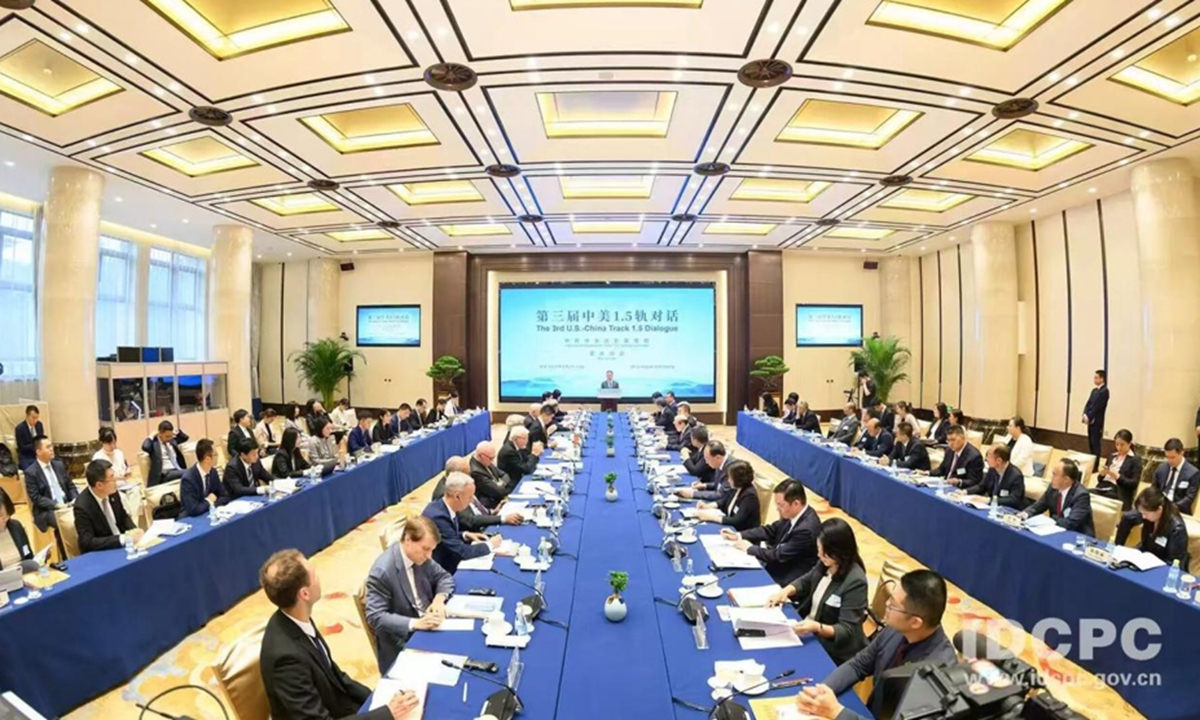
The third China-US Track 1.5 Dialogue was held in Beijing on Tuesday, bringing together government officials, scholars and business representatives from both countries for discussions on constructive strategic stability and practical cooperation.
Co-hosted by the International Department of the Central Committee of the Communist Party of China (IDCPC) and the Asia Society, the dialogue was attended by about 40 representatives. Participants included officials from relevant Chinese government departments and local governments, experts from think tanks and universities, as well as figures from US strategic and business circles, including John L. Thornton, co-chair of the Asia Society Board of Trustees.
Under the theme "Constructive Strategic Stability - Practical China-US Cooperation in the New Era," the participants held candid, in-depth and constructive exchanges, according to the IDCPC's release on its WeChat account on Tuesday.
Addressing the dialogue, Liu Haixing, head of the International Department of the CPC Central Committee, said the two sides have recently followed the direction set by the two heads of state, taken practical steps to strengthen communication and dialogue, advanced a positive agenda and achieved notable results.
Liu called on the two countries to continuously enlarge common interests and make cooperation the anchor of positive stability. He urged the two countries to uphold mutual benefit and reject zero-sum games so that competition remains within bounds, to seek common ground while managing differences, and observe the bottom line of no conflict and no confrontation to achieve lasting peace and stability.
Participants discussed ways to enhance political mutual trust, expand economic and trade cooperation, and explore cooperation in artificial intelligence, science and technology, CCTV News reported.
Established in 2023, the China-US Track 1.5 Dialogue operates between formal government-to-government diplomacy, known as Track 1, and purely nongovernmental exchanges, known as Track 2. The second dialogue was held on June 13, 2024, during which participants held candid, in-depth and constructive exchanges around the theme of "sharing perspectives and finding solutions on key and urgent issues."
As a channel involving both government and nongovernmental participants, the Track 1.5 mechanism can help China and the US communicate more effectively, identify common ground and better understand the consensus reached by the two heads of state, Zhou Mi, a senior research fellow at the Chinese Academy of International Trade and Economic Cooperation, told the Global Times on Tuesday.
It can also help translate the consensus into greater mutual understanding and concrete action, Zhou said.
Discussions on AI at this year's dialogue could help the two sides identify shared interests despite existing frictions and technological challenges, creating opportunities for practical cooperation and laying the groundwork for follow-up efforts, he noted.
Wang Yiwei, a professor at the Renmin University of China's School of International Studies, told the Global Times on Tuesday that the Track 1.5 dialogue serves as a bridge between Track 1 and Track 2, allowing participants to discuss sensitive issues and explore policy space while conveying frontline assessments and feasible proposals to decision-making departments.
Liu outlined practical pathways for China-US cooperation in the new era. First, the two sides should uphold mutual respect, peaceful coexistence and win-win cooperation, steer China-US relations to overcome the "Thucydides Trap," and create a new paradigm of major-country relations.
Second, the two countries should jointly shoulder their responsibilities as major powers, make constructive interaction an important driver of international cooperation, address global challenges together and inject greater stability into the world, Liu noted.
Third, they should expand exchanges and cooperation in trade, public health, agriculture, tourism, people-to-people ties, law enforcement and cooperation between localities, thereby strengthening the resilience of bilateral relations and working toward a better future, Liu said.
Overcoming the "Thucydides Trap" fundamentally rejects the notion that conflict between major powers is inevitable, Wang Yiwei said. It reflects an effort by China and the US to pursue a path different from the historical confrontation between an established power and a rising one.
Such a model does not seek to avoid competition altogether, but to ensure that competition has boundaries, differences remain manageable and cooperation retains sufficient space, Wang Yiwei said.
To put this approach into practice, the two countries should respect each other, avoid crossing red lines concerning core interests and reduce the risk of strategic miscalculation. They should expand areas where their interests converge and establish regular cooperation mechanisms on global issues such as climate change, public health, food security and AI safety, turning shared responsibilities into joint action, he noted.
As the world's two largest economies, China and the US should recognize that many global challenges cannot be effectively addressed without coordination between them, particularly at a time of intensifying competition. Constructive engagement is therefore not a temporary expedient but a long-term responsibility that major countries should undertake for the world, Wang Yiwei said.
The dialogue came a day after China's top political advisor Wang Huning met with US delegates attending the event in Beijing on Monday.
During their meetings, the US side said that the US-China relationship is at a special juncture, adding that the sound rapport between the two heads of state constitutes the most valuable and important part of bilateral ties. The US side agrees that both sides should act on the consensus of building a constructive US-China relationship of strategic stability, advance corporate cooperation, expand people-to-people and cultural exchanges, guard against risks such as those posed by artificial intelligence, and deliver benefits to both countries and the rest of the world, according to Xinhua.
。 Anil Sharma's Apne starred Dharmendra, Sunny Deol and Bobby Deol. A sequel was in the talks about following the veteran actor's death, Sharma said that Apne 2 has been shelved. However, now producer Deepak Mukut has confirmed that the sequel is happening, and it is their tribute to Dharmendra. Addressing the buzz head-on Deepak Mukut said, "People need to stop spreading unverified rumours. Apne 2 is not shelved. This film is happening, and it is happening with full conviction. We have been working quietly but consistently, and there has never been a question of dropping the project. Apne 2 is not only on track but remains one of the most emotionally significant projects undertaken by our banner." Apne 2 Vedanshi Pathak Srijita Sen Headline Apne 2 not shelved, confirms producer Deepak Mukut Summary Apne starred Dharmendra, Sunny Deol and Bobby Deol in key roles. Anil Sharma's Apne starred Dharmendra, Sunny Deol and Bobby Deol. A sequel was in the talks about following the veteran actor's death, Sharma said that Apne 2 has been shelved. However, now producer Deepak Mukut has confirmed that the sequel is happening, and it is their tribute to Dharmendra. Addressing the buzz head-on Deepak Mukut said, "People need to stop spreading unverified rumours. Apne 2 is not shelved. This film is happening, and it is happening with full conviction. We have been working quietly but consistently, and there has never been a question of dropping the project. Apne 2 is not only on track but remains one of the most emotionally significant projects undertaken by our banner." He added, "Apne belonged to Dharamji. His presence, his warmth, his soul everything he stood for made that film what it became. Apne 2 is extremely close to my heart. In many ways, the film will be a shradhanjali, a heartfelt homage to Dharamji. We want the sequel to celebrate him, his values, and the emotional world he created with the Deol family on screen." The sequel, which was earlier announced with Dharmendra, Sunny Deol, Bobby Deol and Karan Deol, has been undergoing creative restructuring, but the core intention remains unchanged, to carry forward the emotional legacy of one of Hindi cinema’s most beloved family dramas. Moreover, the essence of Apne 2 has deepened after the loss of Dharmendra, who headlined the original 2007 family drama that became a massive audience favourite. Some time back, Apne director Anil Sharma spoke about the fate of the sequel and shared that, "Apne to apno ke bina nahi ho sakti. (Apne cannot happen without close people). Without Dharamji, it’s impossible to make the sequel. Everything was on track and the script was ready, but he left us. Some dreams remain unfulfilled. Without him, it’s not possible!" Also Read: Anil Sharma Reveals Fate of Dharmendra, Sunny Deol and Bobby Deol Starrer Apne 2。
Current article:http://s6x1.ruidunguizanpaorangchongouxia.sbs/cgtt4p/20260826/1077.html
Published on:15:08:19
王者荣耀_Random reading
- 08-22CBI summons Sisodia for questioning in Delhi excise policy case
- 08-22罗马诺独家:过去48小时,包括莱比锡在内多家球队询问卡萨多情况
- 08-25冬至暖情:前进小步幼儿园里的美食盛宴
- 08-25集群化、智能化、融合化 山西临汾瞄准五百亿级装备制造新高地,集群化、智能化、融合化 山西临汾瞄准五百亿级装备制造新高地
- 08-23FS社独占新作性能堪忧:Switch 2输入延迟严重
- 08-20机器人障碍赛亮出“真功夫”
- 08-22666万福利来袭! 广西福彩快乐8盛夏狂欢节今日正式开启
- 08-23换季式降温来了!冷空气预约“国庆档”
- 08-22安世中国发布多款12英寸新品
- 08-22友人に10人分の弁当を頼まれた→朝一気に作っていくと…… 圧巻の光景に「これはプロ」「す、すごい」「私も注文したい」

豆瓣_Active users
- 广告联盟是什么?2026年最全小白入门指南
- 3对6只包赔!京东生鲜自营大闸蟹大促:99元送上门
- 福州民政部门全力构建“幸福守护链”见闻:有福之州 温暖常在
- 两厢电动小钢炮 标致e-208GTi将于6月13号正式发布!
- 以军袭击联合国车辆致1死1伤,古特雷斯呼吁彻查
- 六大AI模型被扔进加密市场厮杀,DeepSeek暂为交易之王
- 研究内容晚了一天,投顾服务时效应该怎样验收
- 乘车遗忘手提袋 民警快速帮寻回
- 谱写高质量发展新篇章
- 回应球真牛!雷蒙攻防都有贡献 9中4&三分4中2拿到11分4前场板
- 暴風主場死磕天空
- コーヒーはいつ飲むべき? エネルギー補給にベストなタイミングを栄養士が解説
- 大力优化营商环境 加快高质量发展|零工市场+零工超市,破解用工就业“两头难”
- AI工具导航网站,未来的发展前景怎么样?
- 【收评】纯碱日内下跌1.05%机构称纯碱基本面宽松不改,期价底部震荡
- 36.1万“法律明白人”活跃在基层
- 关于“乘风起”即开型体育彩票游戏上市销售的公告
- 42岁詹皇沦为背景!布朗训练肌肉照刷屏,满身腱子肉全是复仇战意
bilibili_Hottest this week
- 我的前半生 copyright
- Some of the content comes from the Internet. If you have any offence, please raise it.